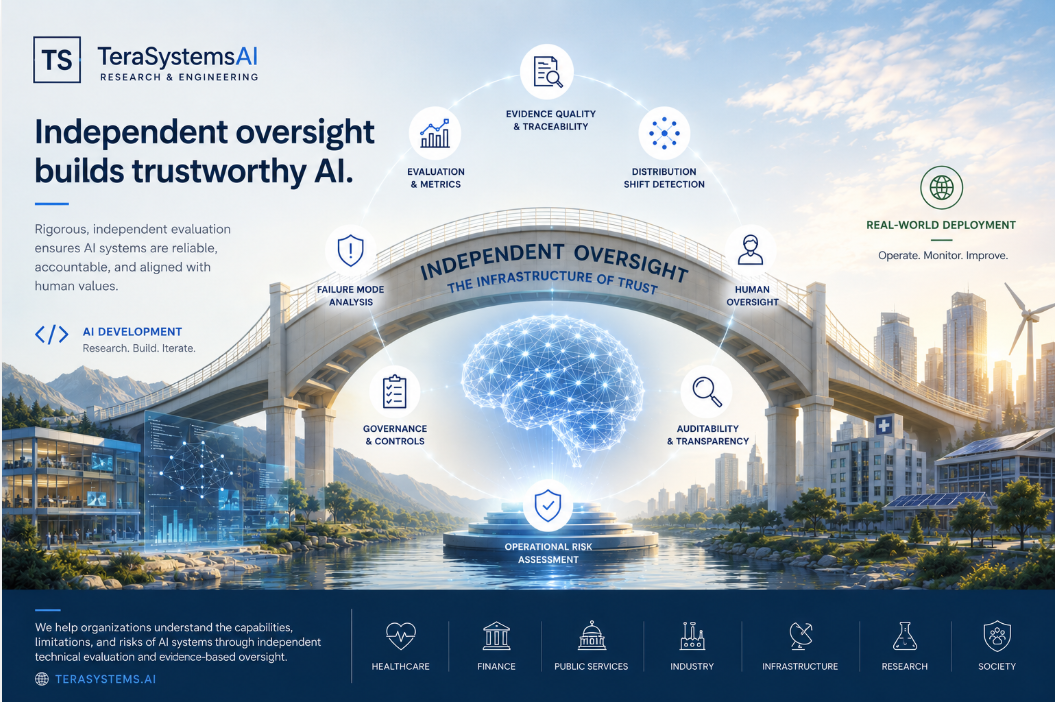
Modern AI systems increasingly influence healthcare, finance, public services, scientific research, critical infrastructure, and enterprise decision-making. Their benefits are substantial, and so are the consequences of failure. Technical excellence alone is no longer sufficient, which raises a question that will define the next decade of the field: who evaluates the systems that evaluate everything else?
For decades, society has answered similar questions through independent auditing, safety inspection, peer review, and regulatory oversight. These mechanisms were not created because builders are untrustworthy. They were created because complex systems require independent evaluation. AI is now reaching the same point.
Key Takeaways
- Organizations developing AI operate under technical, commercial, and organizational pressures that naturally limit objective self-assessment.
- Independent oversight complements internal governance; it does not replace it.
- Because AI systems keep changing after deployment, oversight is a continuous process, not a one-time event.
- Trustworthy AI requires more than benchmark performance; it requires independent evaluation of evidence, uncertainty, failure modes, and operational risk.
- As AI systems become more consequential, independent oversight becomes foundational infrastructure for responsible deployment.
- TeraSystemsAI aims to help establish independent AI evaluation as a recognized engineering discipline.
The ProblemBuilders are not the best judges of their own systems
The people who build an AI system possess unparalleled technical knowledge about its design. They also carry unavoidable constraints that limit objective evaluation. Development teams work under deadlines, product roadmaps, customer expectations, competitive pressure, and significant investment in their own design decisions. Over time, familiarity with a system can create blind spots that are invisible to those closest to the work.
This is not a criticism of integrity; it is a recognition of how human decision-making works. Incentives, proximity, and complexity combine to make objective self-assessment genuinely difficult. Every mature engineering discipline has learned the same lesson. Financial statements undergo external audits. Aircraft undergo independent certification. Medical research relies on peer review and regulatory evaluation. These practices exist because expertise alone does not eliminate bias, and AI should be no different.
Why It MattersTrust at scale requires external verification
Internal testing remains indispensable. Organizations must validate their models, monitor production behavior, evaluate security, and continuously improve performance. But internal review answers only part of a larger question. External stakeholders, including customers, regulators, investors, clinicians, engineers, and the public, must also understand why a system deserves trust.
Independent oversight provides a perspective unavailable to internal teams, because it asks different questions. Rather than asking only whether the model performs well, it also asks:
- Under what conditions does it fail?
- How reliable are its confidence estimates?
- What evidence supports each decision?
- How does performance change under distribution shift?
- Which risks remain insufficiently mitigated?
- Are governance controls appropriate for deployment?
These questions become more important as AI systems influence decisions affecting people's health, finances, safety, and rights.
Why AI Is DifferentOversight that does not end at deployment
There is one characteristic that sets AI apart from finance, aviation, and medicine. Unlike most traditional engineering systems, modern AI systems continue to interact with changing data, evolving environments, and new patterns of use after they are deployed, and their behavior can shift as those conditions change. A bridge does not learn. A financial statement does not update itself every hour. A foundation model, and the data and context around it, evolve continuously. Independent oversight of AI is therefore not a one-time certification but an ongoing process of evaluation, monitoring, and reassessment across the entire system lifecycle. This is what distinguishes AI oversight from ordinary auditing, and why it has to be designed as a continuous discipline rather than a single gate.
What It ExaminesIndependent oversight is broader than model accuracy
A thorough evaluation considers many dimensions of system reliability, not a single performance number. In practice, the questions fall into four areas.
Technical Reliability
- Robustness
- Uncertainty calibration
- Failure modes
- Distribution shift
Evidence and Transparency
- Traceability
- Documentation
- Reproducibility
- Auditability
Operational Readiness
- Monitoring
- Human oversight
- Incident response
- Rollback capability
Governance
- Accountability
- Compliance
- Risk management
- Decision authority
The objective is not to prove that a system is perfect. It is to understand where confidence is justified, and where caution remains necessary.
Within that, uncertainty deserves particular attention. Independent oversight should evaluate not only whether a system's predictions are accurate, but whether the system understands the limits of its own knowledge. Reliable uncertainty estimation is what separates justified confidence from unsupported certainty, and it is often the difference between a system that fails safely and one that fails silently. Examining how well a system represents its own uncertainty is, for that reason, central to judging whether it can be trusted in high-stakes use.
The TeraSystemsAI PerspectiveIndependent review as infrastructure for trust
At TeraSystemsAI, we view independent oversight as a technical discipline rather than a compliance exercise. Our vision is to help establish independent AI evaluation as a recognized field of engineering, one that combines technical assessment, governance analysis, uncertainty evaluation, evidence review, and operational risk assessment to improve confidence in high-stakes AI systems. Trust does not emerge from claims; it emerges from evidence that has survived independent scrutiny.
We do not certify, approve, or replace organizational accountability. Final responsibility always remains with the organization deploying the system. Our contribution is independent technical scrutiny that helps decision-makers understand both the strengths and the limitations of the systems they rely upon. Independent oversight does not remove risk; it makes risk more visible, measurable, and manageable.
Practical ImplicationsBuilding oversight into the development lifecycle
Independent review is most valuable before deployment, not after failure. Organizations should integrate external evaluation alongside system development rather than treating it as a final compliance checkpoint. That means being prepared to examine the supporting evidence, the uncertainty estimates, the governance controls, the operational assumptions, the monitoring strategies, and the contingency plans that stand behind a system.
As AI systems become more capable, the consequences of incorrect deployment become more significant. Independent oversight does not slow innovation; it strengthens the confidence that innovation deserves.
Looking AheadThe future of trustworthy AI
The future of trustworthy AI will not be built solely by those who design intelligent systems. It will also depend on those willing to examine those systems independently, challenge their assumptions, identify their limitations, and communicate their risks with technical rigor. The concerns running through this work, uncertainty, distribution shift, human oversight, evidence, governance, and failure analysis, are not separate topics; together they describe a single engineering practice, building AI whose limits are understood and respected.
Trustworthy AI will not be achieved by increasingly capable models alone. It will be achieved by increasingly rigorous engineering, transparent evidence, meaningful oversight, and the willingness to question our own systems before the world has to. Just as independent auditing became fundamental to modern finance, independent AI evaluation is likely to become fundamental to responsible AI. That is the long-term case for independent oversight, and it is the discipline TeraSystemsAI is being built to advance.
Work with us on trustworthy AI
Join a community of researchers and engineers building accountable, evidence-grounded systems.
Join the Community