Generative AI has transformed document processing. Tasks that once required hours of manual review can now be completed in minutes. Yet increased speed introduces a new challenge: when an AI system influences regulatory, legal, financial, or clinical decisions, organizations must be prepared to answer a simple question. Why should anyone trust this result?
The answer cannot simply be that the model performed well. Trust requires evidence. It requires traceability. It requires accountability. These requirements are what distinguish a document assistant from a regulatory-grade document workflow.
Key Takeaways
- Regulatory-grade workflows are built around evidence, transparency, and accountability, not simply automation.
- Every conclusion should be traceable to verifiable source material.
- Human review should occur where judgment and responsibility matter most.
- Confidence estimates, provenance, and audit trails turn AI outputs into defensible decisions.
- TeraDocFlow is designed around these principles from the beginning rather than adding them after deployment.
The ProblemFluent output is not a compliant process
Modern language models generate remarkably fluent responses. Unfortunately, fluency is not evidence. A response may appear accurate while lacking traceable support, omitting relevant context, or relying on information that cannot later be verified. In regulated environments, this distinction is critical, because regulators, auditors, courts, and organizational leaders evaluate not only the final answer but the process that produced it.
They expect organizations to demonstrate which documents were consulted, which evidence supported the conclusion, how uncertainty was handled, what human review occurred, and whether the decision can be reconstructed months or years later. A system optimized solely for output quality cannot satisfy these requirements. The gap between a capable document assistant and a regulatory-grade workflow is therefore a gap in process, not merely a gap in model performance.
Why It MattersDefensibility is the true requirement
Organizations operating in regulated industries make decisions that affect patients, customers, investors, employees, and society, and those decisions must remain defensible long after they are made. When questions arise, organizations need more than convincing language. They need evidence. They need provenance. They need records. They need confidence estimates that communicate both what the system knows and where uncertainty remains.
A workflow that cannot provide these elements creates operational, legal, and reputational risk regardless of how often the underlying model produces correct answers. Trustworthy workflows are therefore designed to withstand scrutiny, not simply to maximize automation.
What It RequiresThe components of a regulatory-grade workflow
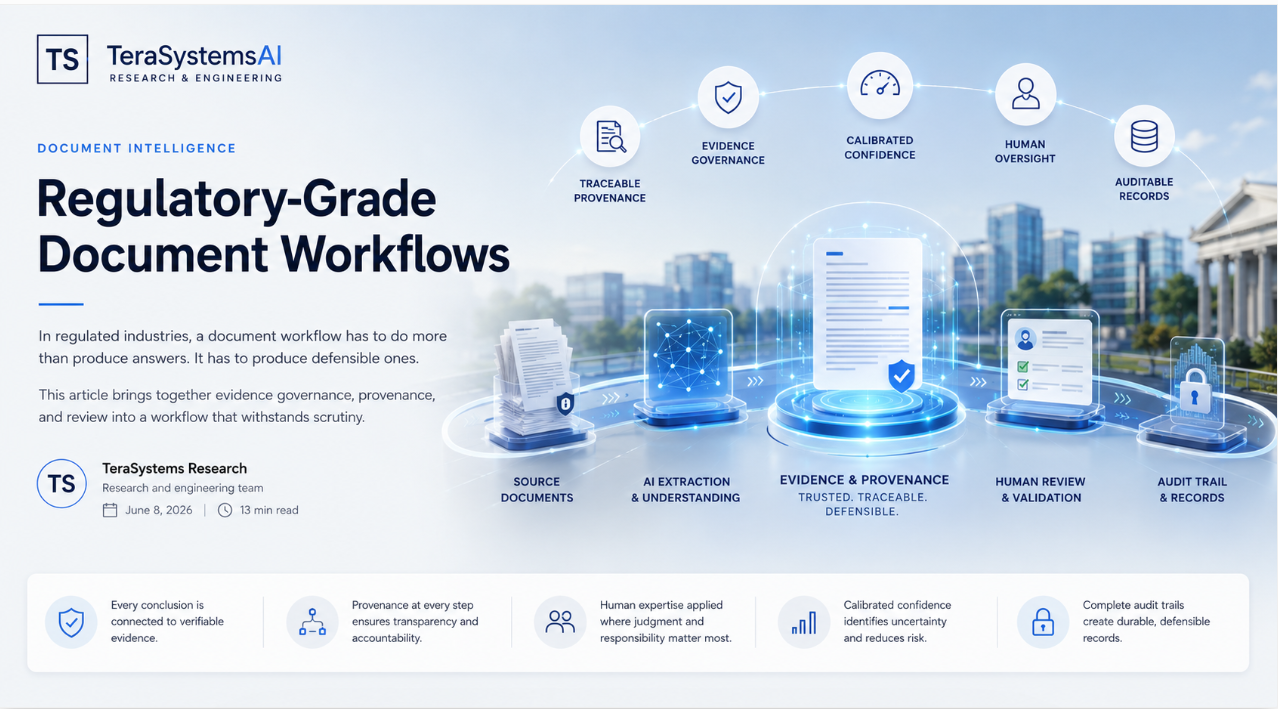
A trustworthy document workflow integrates several complementary capabilities, each of which preserves something a later reviewer will need.
Evidence Governance
Every conclusion should remain connected to the source material supporting it. Evidence should never disappear during processing.
Provenance
Traceability is what enables verification. The workflow should always be able to show:
- which document was used
- which section supported the conclusion
- which version was processed
- and when it was evaluated
Calibrated Confidence
Reliable systems distinguish high-confidence conclusions from uncertain ones. Rather than presenting every answer with equal confidence, regulatory-grade workflows communicate uncertainty honestly and escalate ambiguous cases for review.
Human Review
Human expertise should be concentrated where judgment creates the greatest value. AI accelerates review, but humans remain accountable for consequential decisions.
Complete Audit Trails
Every significant event should be recorded, including uploaded documents, extracted evidence, model version, prompts, retrieved passages, reviewer actions, approvals, revisions, and final decisions. Auditability should be a natural outcome of the workflow rather than an additional reporting task.
The TeraSystemsAI PerspectiveCompliance begins with architecture
At TeraSystemsAI, we believe regulatory compliance cannot be added after deployment. It must be reflected in the architecture of the system itself. Every stage of document processing should preserve the information required to explain, verify, and defend the resulting decision. In practice, that means integrating evidence-grounded retrieval, provenance tracking, uncertainty-aware reasoning, structured human review, operational controls, and comprehensive audit logging.
The objective is not simply to automate document processing. It is to improve decision integrity while preserving accountability. TeraDocFlow is being developed around this philosophy from the beginning.
Practical ImplicationsDesigning for tomorrow's questions
The most important design question is not whether the system can answer correctly today. It is whether the organization can explain and defend this decision tomorrow. That mindset changes how a workflow is built. Organizations begin designing for future audits rather than present convenience. They preserve evidence rather than discard it. They measure uncertainty rather than ignore it. They define review points instead of assuming automation is sufficient. They create durable records, because important decisions deserve durable explanations.
Looking AheadThe future of document intelligence
As AI becomes more integrated into regulated industries, organizations will be judged not only by the quality of their decisions but also by the transparency of the processes behind them. The future of document intelligence therefore lies beyond automation. It lies in workflows that combine intelligent assistance with evidence governance, calibrated confidence, human accountability, and complete traceability.
The most valuable document systems will not simply answer questions. They will help organizations answer the harder one: can we confidently defend this decision? That is the standard for regulatory-grade document workflows, and it is the foundation on which TeraDocFlow is being built.
Work with us on trustworthy AI
Join a community of researchers and engineers building accountable, evidence-grounded systems.
Join the Community