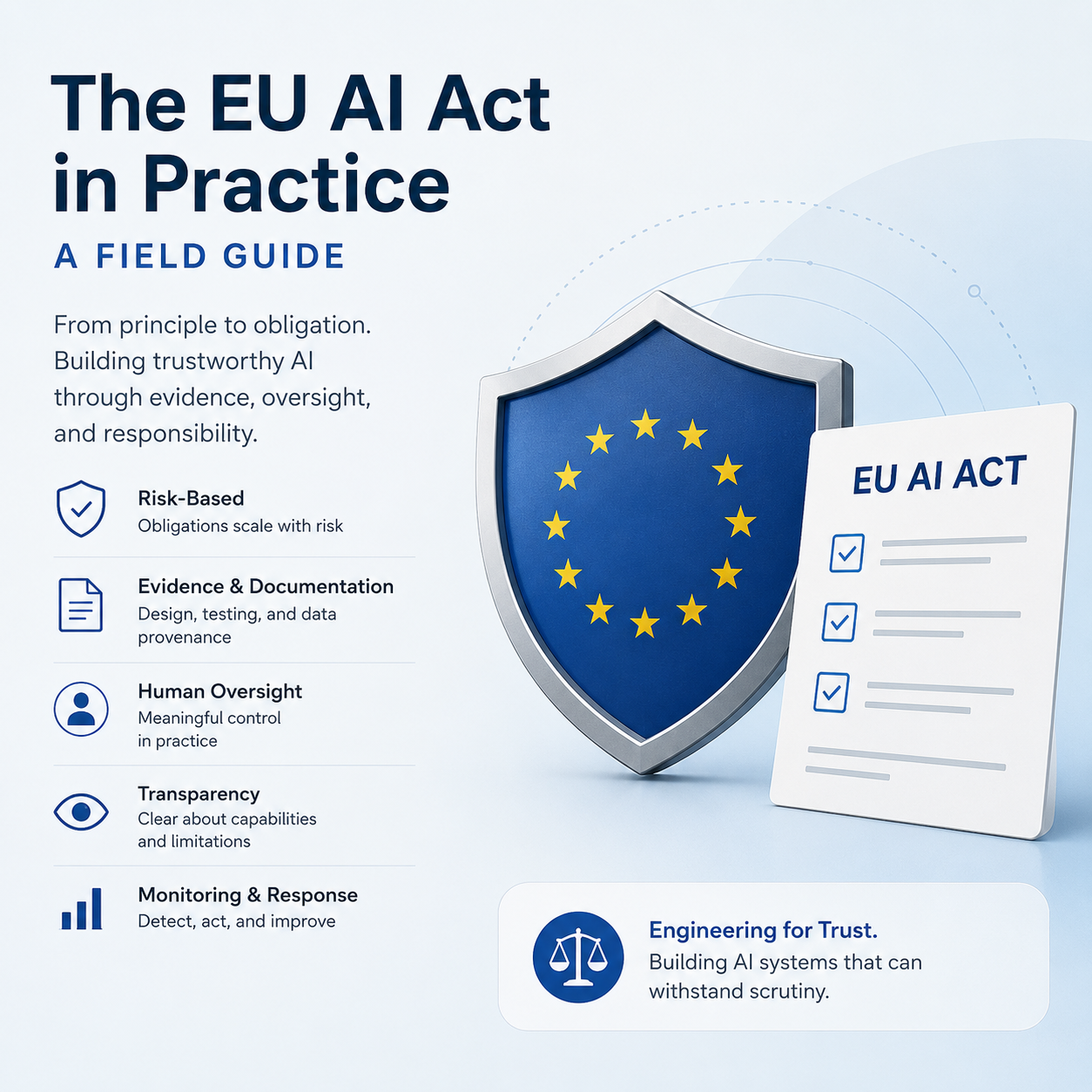
Regulation has a way of turning good intentions into concrete duties. The EU AI Act is the most prominent example for artificial intelligence: it takes principles the field has debated for years, including human oversight, transparency, and risk management, and gives them the weight of obligation for organizations operating in or selling into the European market. For most teams, the useful question is not what the Act says in the abstract, but what it asks them to do in practice.
Key Takeaways
- The Act takes a risk-based approach: the more consequential the use, the heavier the obligations.
- For higher-risk uses, it emphasizes documentation, data governance, human oversight, and transparency.
- Much of what it asks mirrors the engineering practices trustworthy teams already value.
- Preparing early, around the durable core, is far easier than retrofitting under a deadline.
The ProblemFrom principle to obligation, under uncertainty
For years, responsible AI was largely voluntary: teams adopted the practices they believed in, at the pace they chose. A binding regulation changes that calculus. What is expected of a system now depends on how it is classified, what evidence exists for how it behaves, and whether the right controls are documented and actually operating. The difficulty many organizations face is acting before every detail is fully settled, because waiting for total clarity means arriving unprepared. The practical path is to prepare around the durable core of the Act rather than the parts still being interpreted.
Why It MattersObligations follow the level of risk
The central idea of the Act is to match obligations to risk. Everyday, low-stakes uses carry light requirements. Uses that can meaningfully affect people's safety, rights, or access to essential services carry heavier ones. And a small set of practices considered unacceptable are ruled out altogether. The practical consequence is that your first task is honest classification: understanding where each of your systems sits, how it is used, and therefore what is expected of it. Getting that judgment wrong in either direction is costly, since over-classifying wastes effort while under-classifying leaves real obligations unmet.
What It AsksThe core duties, in practice
For higher-risk uses, the Act's requirements tend to cluster into a few themes. None of them will surprise a team that already takes trustworthy AI seriously.
Risk Classification
- Know where each use sits on the risk spectrum
- Record the basis for that judgment
Data and Documentation
- Evidence of data quality and governance
- Records of how the system was built, tested, and behaves
Human Oversight
- Oversight that is operational, not symbolic
- People with the information, authority, and time to intervene
Transparency
- Clear account of capabilities and limitations
- Where relevant, making clear when people interact with AI
Read together, these are less a compliance burden than a description of a system whose behavior can be explained, evidenced, and overseen. That is the point worth holding onto.
How to PrepareSteps you can take before the details settle
Preparation does not require final regulatory certainty. A team can make real progress now by working through a short, durable set of steps:
- Inventory your AI: know what you develop or deploy, and how each system is actually used.
- Classify by risk honestly, and write down the reasoning behind each classification.
- Build the evidence base: design and testing records, data provenance and quality, and known limitations.
- Make human oversight real, so reviewers can question, override, stop, or escalate a system when needed.
- Be transparent about what each system can and cannot do.
- Put proportionate monitoring and an incident plan in place for the systems that matter most.
- Keep documentation current as systems change, so the record always matches reality.
The TeraSystemsAI PerspectiveCompliance is engineering, not paperwork
Our view is that the Act is best met as an engineering discipline rather than a documentation exercise added at the end. Records of how a system was built and tested, evidence of data governance, meaningful human oversight, and transparency about capabilities and limitations are properties a trustworthy system should already have. Teams that treat these as genuine design conditions produce systems that are both more compliant and more dependable. Teams that treat them as forms to complete after deployment achieve neither. Regulation, approached well, simply raises the floor toward practices that serious builders already value.
A Note on ScopeWhat this guide is, and is not
This field guide is general information written to help teams prepare, and it is not legal advice. The Act's specifics continue to be interpreted and phased in over time, and the exact obligations that apply depend on your systems, how they are used, and your jurisdiction. Treat the durable principles here as a starting point, and confirm any specific requirement against current official sources and qualified legal counsel before making compliance decisions. The goal of this guide is not to tell you what the law requires in your case, but to help you build systems that are ready to meet reasonable scrutiny whatever the details turn out to be.
Work with us on trustworthy AI
Join a community of researchers and engineers building accountable, evidence-grounded systems.
Join the Community