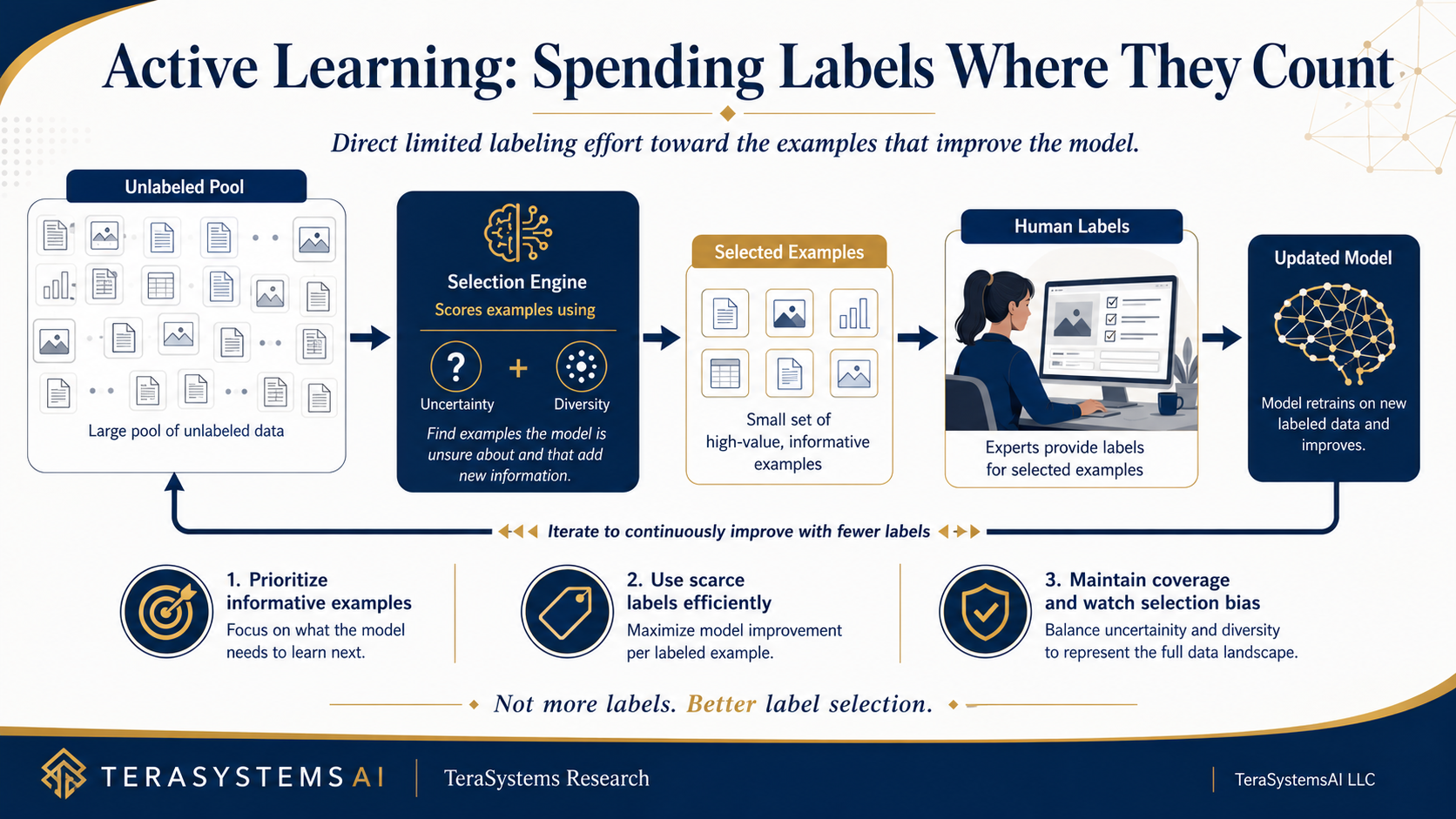
Labeling can be one of the most expensive parts of building a machine-learning system, and not every additional label provides the same learning value. Random sampling remains an important baseline, but it does not explicitly prioritize examples according to how much they may improve the model. Active learning asks a more targeted question: of all the examples we could label next, which ones are likely to provide the most useful information?
Key Takeaways
- Not every additional label provides the same learning value.
- Model uncertainty can help identify informative examples, but uncertainty alone is not sufficient.
- Useful acquisition strategies can combine uncertainty, diversity, representativeness, and task-specific value.
- Active selection changes the labeled-data distribution, so coverage and selection bias must be monitored.
The Problem Not every label has equal value
As a model learns, additional examples from already well-represented regions may contribute relatively little new information. Other examples can expose uncertain decision boundaries, poorly represented regions, changing conditions, or weaknesses in the current model.
But the most uncertain example is not automatically the most useful one. High uncertainty can reflect a lack of knowledge that additional evidence may reduce, or it can reflect inherent ambiguity, noise, or disagreement that more labels may not resolve. Active learning therefore works best when uncertainty is interpreted rather than treated as an automatic acquisition rule.
Why It Matters Label efficiency without losing coverage
When labels require expert review, adjudication, laboratory measurement, or substantial human effort, deciding what to label becomes an allocation problem. Active learning can make limited labeling budgets more effective by directing attention toward informative cases.
The objective is broader than simply reducing annotation volume. A useful strategy must preserve enough coverage to detect regions that the acquisition rule may otherwise neglect. Random or representative sampling remains valuable as a comparison baseline and as a way to preserve visibility into the broader operating population.
The TeraSystemsAI Perspective Let uncertainty inform labeling, not control it
At TeraSystemsAI, we view uncertainty as one source of evidence for deciding what should be labeled next. Examples associated with reducible uncertainty can reveal where additional information may improve the model. But uncertainty should be considered alongside diversity, representativeness, operational importance, and the cost of obtaining a reliable label.
The stronger question is not only, Where is the model least confident? It is also: Why is it uncertain? Is this example representative? Is it redundant with cases already selected? Does it improve coverage? Does it matter to the intended use?
That turns labeling into an evidence-guided allocation decision rather than a simple uncertainty ranking.
Practical Implications Target labels without narrowing the view
A practical active-learning loop begins with a labeled seed set, trains a model, evaluates an unlabeled pool using an acquisition strategy, sends selected examples for human labeling, updates the model, and repeats. Depending on the problem, acquisition can use predictive uncertainty, diversity, representativeness, expected model change, or combinations of these signals.
Governance matters as much as selection. Teams should track which examples, classes, subgroups, and regions of the data distribution are being queried. They should preserve representative evaluation data outside the acquisition loop and periodically compare the active-learning strategy against a simple baseline.
The goal is not to label only what the model finds difficult. The stronger principle is:
Core Principle
Spend scarce labeling effort where evidence indicates it can improve learning, while preserving enough coverage to detect what the acquisition strategy may be missing.
Work with us on trustworthy AI
Join a community of researchers and engineers building accountable, evidence-grounded systems.
Join the Community