A model that produces an incorrect answer can mislead a user. A tool-using agent can go further: it can send a message, modify data, invoke an API, trigger a workflow, deploy code, or initiate another action.
That difference matters.
Once an AI system can act on external systems, errors can become consequences rather than merely incorrect outputs. The value of agents comes from their ability to act. The risk comes from the same capability.
The central engineering question is therefore not:
How autonomous can we make the agent?
It is:
What authority should the agent have, under which conditions, and when must it stop, escalate, or request authorization?
Key Takeaways
- Tool-using agents extend both capability and risk because mistakes can become actions.
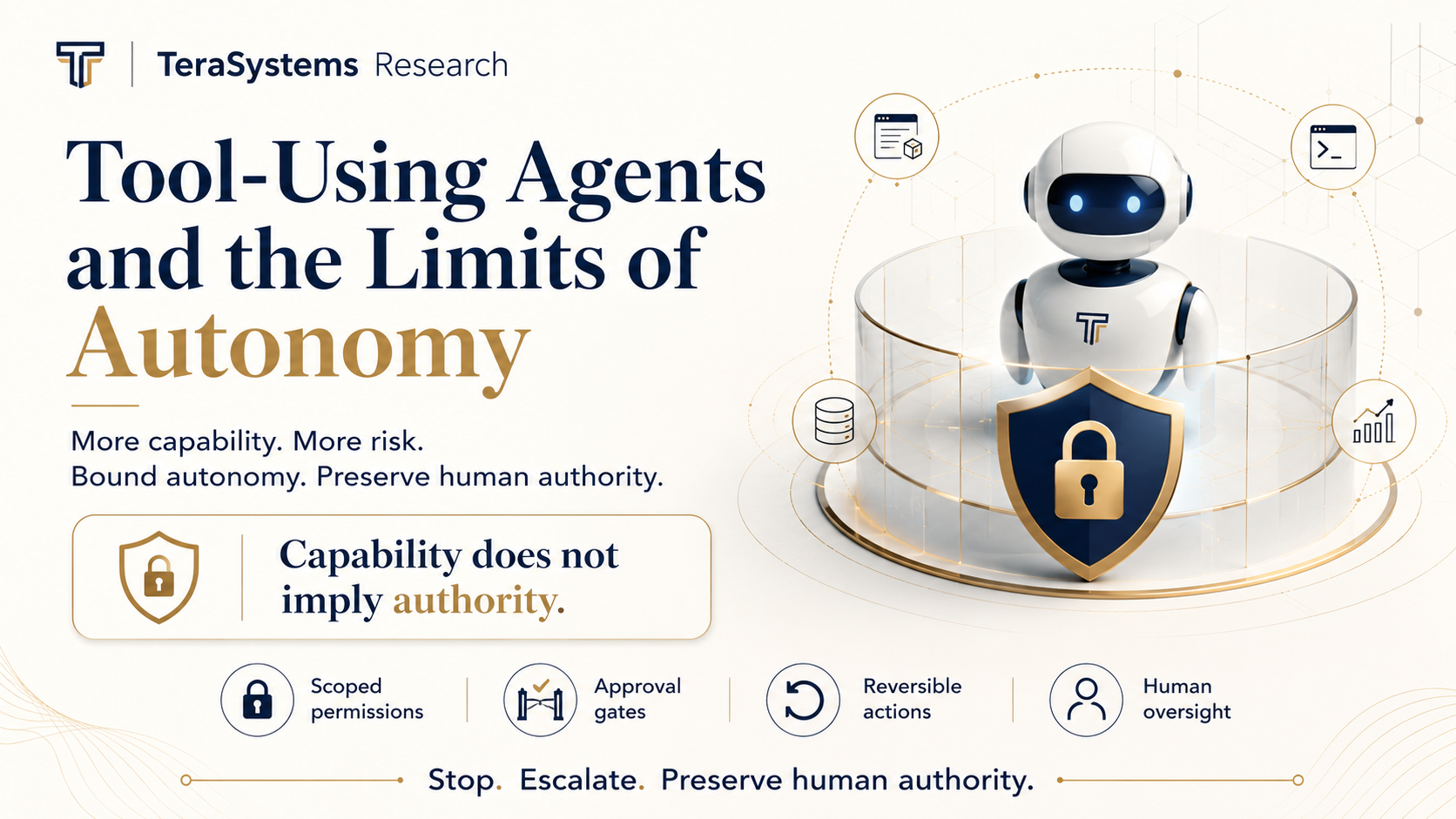
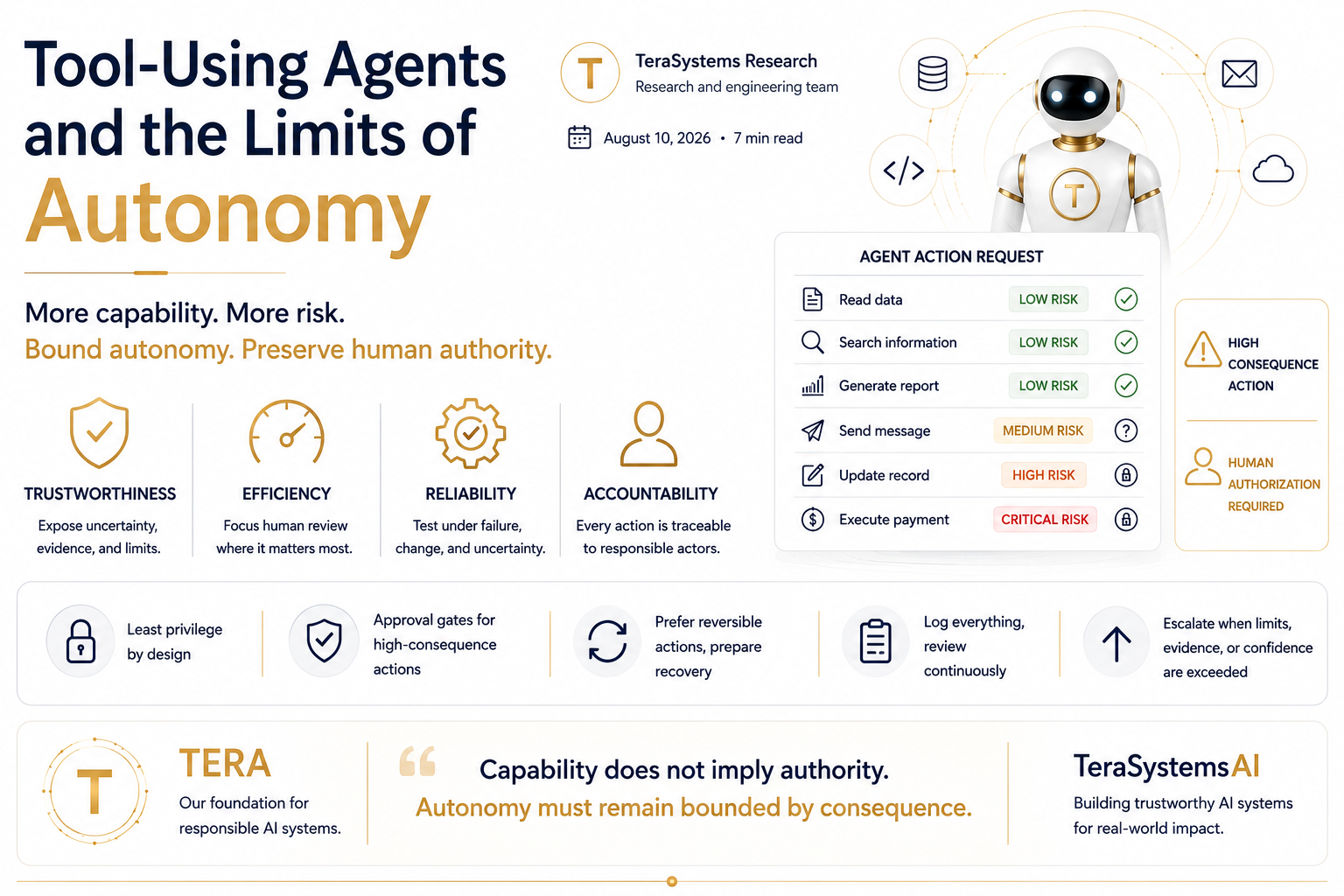
- Capability does not imply authority. What an agent can do and what it is permitted to do are different questions.
- Autonomy should be bounded by consequence, reversibility, permissions, resources, and operating context.
- Higher-consequence or difficult-to-reverse actions require stronger controls.
- Human oversight must provide real information, authority, and opportunity to intervene.
- Safe agent design requires explicit boundaries for continuation, approval, escalation, and stopping.
The ProblemAutonomy turns errors into actions
When a model is used only for advisory output, a human can remain between the recommendation and the resulting action.
Tool-using agents can reduce or remove that buffer.
An agent may observe information, form a plan, invoke a tool, inspect the result, and continue through additional steps. That makes agents useful, but it also creates a compounding-risk problem.
A misunderstanding early in a sequence can influence a tool call. That action can change the environment, and the changed environment may then become new input for the next decision.
The result is no longer simply an incorrect sentence.
It can become an incorrect state of the world.
As action chains grow, systems therefore need clear boundaries defining where the agent may continue independently and where it must stop.
Why It MattersCapability is not authority
A system may be technically capable of sending an email, modifying a database, purchasing a service, publishing content, moving a file, or deploying software.
That does not mean it should be authorized to perform those actions automatically.
The appropriate level of autonomy depends partly on the consequences of being wrong.
A reversible draft is different from a public message. A database preview is different from a destructive write. A recommendation is different from a financial transaction. A temporary configuration change is different from releasing sensitive information that cannot realistically be retrieved once disclosed.
For consequential actions, authority boundaries should exist before execution, not be inferred afterward.
Autonomy Is Not One SettingAuthority has multiple dimensions
Autonomy is often discussed as if an agent were simply autonomous or not autonomous. Real systems are more complicated.
An agent may have different degrees of authority across several dimensions:
These dimensions should be designed deliberately. Complex reasoning capability does not justify unrestricted authority.
The TeraSystemsAI PerspectiveBounded autonomy, preserved authority
At TeraSystemsAI, our position is that autonomy should be earned, scoped, and bounded, not assumed.
Low-consequence and reversible actions may be automated within clearly defined permissions and operating limits. As consequence increases, so should the strength of authorization, verification, and oversight.
When an action is difficult or impossible to reverse, stronger controls should exist before execution.
The objective is not to maximize how much an AI system can do without a person. The objective is to determine where independent action is appropriate while preserving meaningful human authority over consequential decisions.
An agent should not be expected to know its limits by intuition. Those limits must be engineered.
Reaching the edge of permission, evidence, confidence, or operating scope should be treated as a control signal, not an invitation to improvise.
TERA and Agent AutonomyFour principles for bounded action
The TERA foundation provides a practical way to reason about those boundaries.
Under TERA, autonomy is not measured by how much an agent can do without a person.
It is measured by whether authority, evidence, constraints, reliability, and responsibility remain intact while the system acts.
Practical ImplicationsPermissions, reversibility, and escalation
A trustworthy tool-using agent should begin with the principle of least necessary authority.
Give the system the tools and permissions required for its task, not every capability available in the surrounding environment.
These mechanisms do not eliminate risk. They make risk more visible, bounded, and governable.
Human OversightOversight must preserve decision authority
Adding a person somewhere in an agent workflow does not automatically create effective human oversight.
A reviewer needs enough information to understand what is being proposed. They need sufficient authority to reject, modify, stop, or escalate the action.
The system should also preserve evidence of what was presented, what decision was made, and what happened afterward.
A human approval button without context or actual decision authority is not sufficient governance.
Human oversight should preserve decision authority, not merely create the appearance of supervision.
The Design PrincipleAct where authority is clear. Stop where it ends.
The strongest agent is not necessarily the one allowed to operate the longest without intervention.
A well-designed agent operates within an explicitly engineered boundary.
It can act where authority is clear. It can pause where evidence is insufficient. It can escalate where consequences increase. And it can stop where permission ends.
The goal is not to build an agent that never needs a person.
The goal is to build a system in which independent action remains appropriate, bounded, observable, and accountable.
Autonomy must remain bounded by consequence.
When the system reaches the boundary: Stop. Escalate. Preserve human authority.
TERA is applied, not advertised.
Work with us on trustworthy AI
Join a community of researchers and engineers building accountable, evidence-grounded systems.
Join the Community