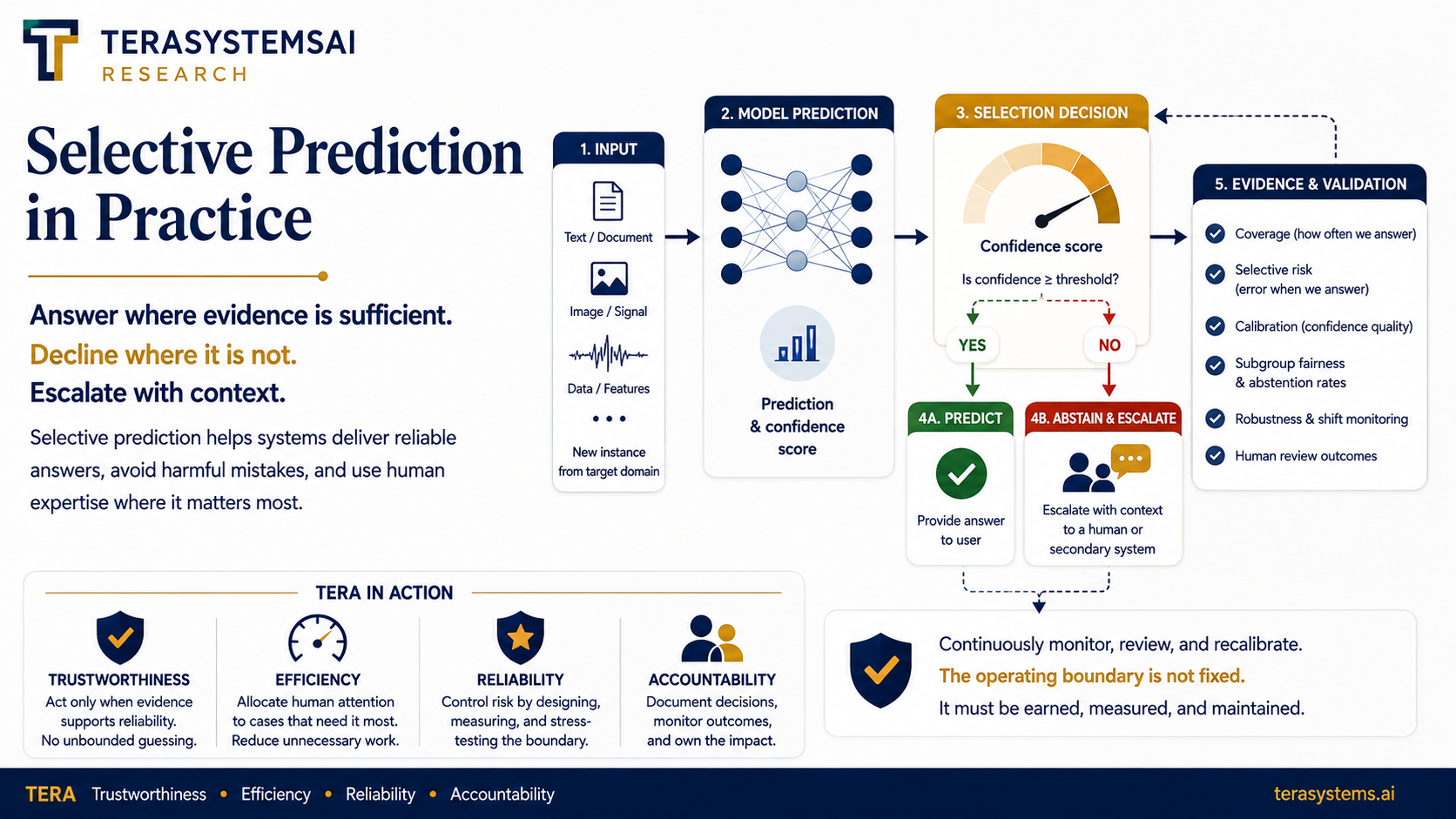
Many AI systems are designed to return an answer for every input. That can make the system appear capable, but forced coverage can hide uncertainty behind confident output. Selective prediction adds another option: answer when the available evidence supports the prediction, and abstain when it does not. The objective is no longer maximum coverage at any cost. It is to determine how much coverage the system can justify at an acceptable level of risk.
Key Takeaways
- Selective prediction separates the decision to answer from the prediction itself.
- The central tradeoff is coverage versus selective risk: answering fewer cases can improve reliability among the cases the system accepts.
- Confidence thresholds should be validated on target data. Calibration is useful, but calibration alone does not guarantee good abstention.
- Deferral has costs of its own, including latency, human workload, and possible unequal burden across groups.
- Abstentions should route to a defined fallback path with enough evidence and context for the next decision-maker.
- The operating threshold must be monitored because the relationship between confidence and error can change under drift.
The ProblemA model forced to always answer
Many predictive systems are designed as though producing no answer were automatically a failure. For every input, the system returns a class, score, ranking, or recommendation.
That behavior is convenient, but it can be dangerous. Some inputs are familiar and well supported by training data. Others are ambiguous, rare, corrupted, adversarial, or outside the conditions the model has learned. If the system has no reject option, these cases still receive predictions.
The problem is not merely that mistakes occur. Every model makes mistakes. The deeper problem is that unsupported predictions can arrive through the same interface and with the same apparent authority as well-supported ones.
Selective prediction adds a second decision: Should the system answer this case at all?
The prediction function and the selection rule should be treated separately. A model may be capable of producing an output for every input while the surrounding system chooses to expose only outputs that satisfy an evidence or risk threshold. That distinction turns abstention from failure into a control mechanism.
The Core TradeoffCoverage versus selective risk
Selective prediction is commonly evaluated through two quantities. Coverage is the fraction of cases on which the system chooses to answer. Selective risk is the error, loss, or other performance measure calculated only on the cases the system accepts.
As the acceptance threshold becomes stricter, coverage usually falls. If the selection signal is informative, risk among the accepted cases should fall as well. This produces a risk-coverage curve rather than a single accuracy number.
The operating point should not be chosen because 70%, 80%, or 90% confidence simply “sounds safe.” It should be selected from target-domain evidence and the relative costs of prediction, abstention, delay, and escalation.
A missed automation opportunity may be inexpensive. A wrong financial decision, access-control action, safety instruction, or other consequential recommendation may be much more costly. The acceptable balance between coverage and abstention therefore depends on consequence.
A system should not be rewarded for coverage it cannot justify.
Most importantly, the boundary is not permanent. Drift can change the relationship between a selection score and observed error. Review capacity can change. Costs can change. New failure modes can appear. A trustworthy selective system therefore treats the operating point as something to earn, measure, monitor, and revise.
The boundary may also need to vary by task or operating context. Some systems may justify different thresholds for different action classes, user populations, data-quality conditions, or downstream consequences. What matters is that those differences are explicit, evidence-based, and reviewable rather than hidden inside implementation details.
That policy should reflect more than confidence alone. It should incorporate the consequence of error, the quality of the available evidence, the capacity of the fallback path, and the conditions under which the system is operating. A threshold that is appropriate for routine low-impact cases may be inappropriate for a high-consequence workflow, even when the underlying model is identical.
The acceptance threshold is often presented as a model setting, but in deployment it is better understood as an operating policy. It determines how much risk the system is willing to accept before a case is routed elsewhere.
The Operating BoundaryA threshold is a policy, not a constant
Why It MattersDeferral has value and cost
It is tempting to say that abstention is always safer than a wrong answer. That is too simple.
Deferral has costs. A declined case may create delay, increase human workload, require specialized expertise, or overload a review queue. If abstentions are concentrated disproportionately on particular populations or operating conditions, they can also shift burden unevenly.
The design question is therefore not “answer or abstain?” in isolation. It is: Which action produces the lowest acceptable risk for this case, given the available evidence and the cost of escalation?
Where appropriate, a selective system may have more than two paths: answer automatically, route to another model or deterministic process, or escalate to a person. Abstention then becomes part of a broader decision architecture rather than an endpoint.
UncertaintyNecessary, but not enough
The intuition behind selective prediction is straightforward: answer when confidence is high and abstain when confidence is low. But model confidence is not automatically trustworthy.
Neural networks can be overconfident. Probability estimates may be miscalibrated. Confidence behavior can change across populations or after deployment. A score that ranks easy and hard cases well during development may fail under distribution shift.
For this reason, selective prediction should not rely on a threshold simply because a model exposes a probability. The selection signal must be validated against target-domain errors.
Calibration is useful when a system needs probabilities that correspond to observed frequencies. But good calibration alone does not prove that a threshold will reliably separate lower-risk from higher-risk cases. Selection quality must be evaluated directly, especially under shift.
Useful evaluation therefore includes risk-coverage curves, calibration diagnostics where relevant, subgroup analysis, failure-case review, and stress testing under expected changes in operating conditions. Related techniques such as out-of-distribution detection or conformal methods can support this architecture, but they address different questions. The central requirement remains the same: the system needs evidence that its decision to answer or decline is reliable enough for the intended use.
The TeraSystemsAI PerspectiveDesign the decline as carefully as the answer
At TeraSystemsAI, we treat abstention as a first-class system behavior. The decline path should be engineered with the same care as the prediction path.
That means defining what triggers abstention, what evidence is retained, where the case goes next, who has authority to resolve it, and how the eventual outcome is recorded.
A useful escalation should not merely say “low confidence.” It should preserve the context needed by the next decision-maker: the input, relevant evidence, candidate output where appropriate, uncertainty or selection signal, reason for abstention, and actions already taken.
The objective is not to make a model appear cautious. It is to make uncertainty operational. A selective system should act where evidence is sufficient, step back where it is not, and preserve enough context for the next stage to make a better decision.
TERASelective prediction as governed behavior
Trustworthiness. The selection rule should be supported by evidence. Confidence, calibration, uncertainty, and known limits should be represented honestly rather than hidden behind forced predictions.
Efficiency. Abstention should concentrate human attention where it creates value. A system that defers everything is safe only in a trivial sense; a system that never defers may create expensive downstream errors. The operating point should account for review capacity, latency, and cost.
Reliability. Risk-coverage behavior should be tested under target conditions, subgroup variation, data-quality problems, and distribution shift. The threshold that worked at launch may not remain appropriate.
Accountability. The system should record why a case was accepted or declined, which threshold and model version were used, where the case was routed, and what happened afterward. Responsibility for the final action must remain identifiable.
Practical ImplicationsThresholds, routing, and monitoring
A production selective-prediction system should make several decisions explicit:
- Define the consequence model. Estimate the relative cost of wrong answers, abstentions, delays, and downstream review.
- Choose a selection signal. Use confidence, uncertainty, ensemble disagreement, conformal criteria, distance measures, or another signal whose behavior can be validated for the system.
- Measure risk against coverage. Evaluate how performance changes as the acceptance threshold moves instead of reporting only full-coverage accuracy.
- Validate on target data. Select thresholds using data that reflects the intended operating environment rather than assuming source-model confidence transfers unchanged.
- Design the fallback path. Specify what happens after abstention: human review, deterministic checks, another model, delayed decision, or safe refusal.
- Preserve context. The reviewer or fallback process should receive enough evidence to act without reconstructing the entire case.
- Audit subgroup behavior. Measure both error and abstention rates across relevant populations and conditions so that deferral does not quietly transfer burden.
- Monitor after deployment. Track coverage, selective risk, calibration where relevant, escalation volume, review outcomes, and drift. Revisit thresholds when conditions change.
Human OversightEscalation must be operational
Human review is not automatically meaningful just because an abstained case is sent to a person. The reviewer needs sufficient context, time, competence, and authority. The queue must also have enough capacity to absorb the workload created by the selection policy.
If the model abstains faster than people can resolve cases, the system has not eliminated risk. It has moved the bottleneck.
The same is true when a person is expected to approve a model recommendation without independent evidence. Escalation should preserve decision authority, not merely transfer a low-confidence output to a different screen.
The Design PrincipleDecline with evidence, not fear
Selective prediction is not about teaching systems to avoid difficult work. It is about distinguishing supported action from unsupported guessing.
A trustworthy system does not need to answer every case. It needs evidence for the cases it chooses to answer, a governed path for the cases it declines, and monitoring that tells us when that boundary is no longer working.
Abstention is not failure. Unbounded guessing is.
The operating principle is simple:
Answer where evidence is sufficient.
Decline where it is not.
Escalate with context.
Monitor the boundary.
TERA is applied, not advertised.
Work with us on trustworthy AI
Join a community of researchers and engineers building accountable, evidence-grounded systems.
Join the Community