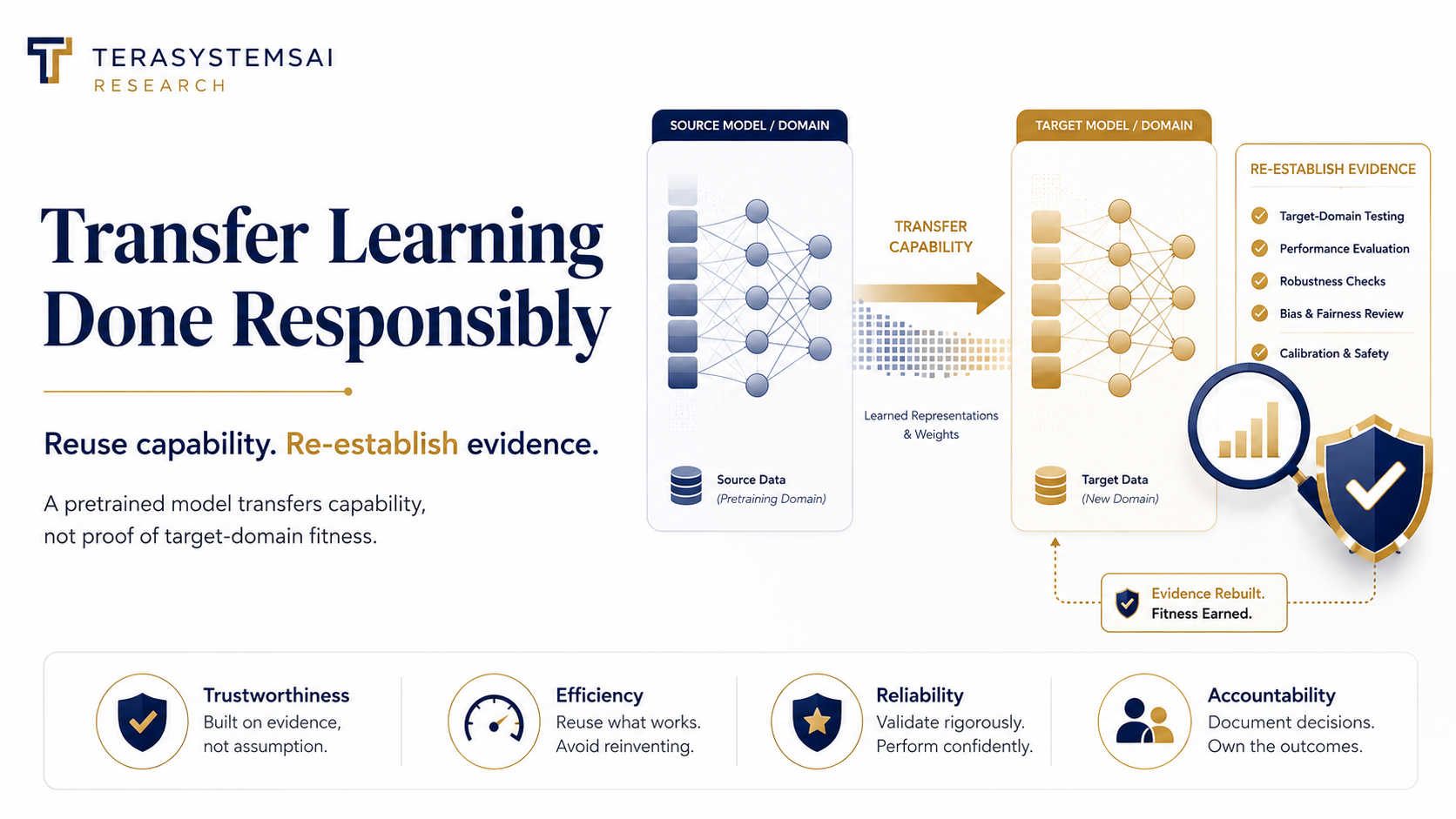
Training a model from scratch is expensive. Transfer learning offers a practical alternative: start with a model that has already learned useful representations, then adapt those representations to a new task or domain.
That can reduce data requirements, shorten training time, and make sophisticated models accessible to teams that could not reproduce the original pretraining process.
But reuse changes the question.
The issue is no longer only whether the pretrained model is capable. It is whether the knowledge it carries is appropriate for the environment in which it will now be used.
Responsible transfer learning therefore requires more than choosing a strong base model and fine-tuning it until a validation score improves. It requires understanding what is being reused, what may fail to transfer, and what must be re-established with target-domain evidence.
Key Takeaways
- Transfer learning can reduce data and compute requirements, but it does not eliminate the need for target-domain validation.
- A pretrained model may carry useful representations together with source-domain assumptions, label conventions, blind spots, and biases.
- Transfer can help, do nothing, or hurt. When reuse degrades target performance, the result is negative transfer.
- Fine-tuning changes model parameters; it does not erase unknown provenance or prove suitability for a new use case.
- Responsible transfer requires provenance, a target-domain baseline, controlled adaptation, calibration, subgroup and stress evaluation, and post-deployment monitoring.
- Reuse should lower training cost, not verification standards.
The ProblemReuse transfers more than useful features
Transfer learning is often described as a shortcut to better performance: take knowledge learned on a source task and reuse it on a related target task.
The shortcut is real, but incomplete.
A pretrained model is not an empty architecture waiting to be filled. Its parameters already encode regularities from the data, objectives, preprocessing choices, labels, and optimization process used during pretraining. Some of those regularities may be broadly useful. Others may be highly specific to the source environment.
Earlier layers in a deep model can sometimes capture relatively general patterns, while later representations become increasingly specialized to the original task. The farther the target task is from the source task, the less safe it is to assume that all learned features will transfer equally well.
That is why transfer learning should be treated as a hypothesis about useful reuse, not as proof that the source model is appropriate for the target domain.
Why It MattersSource success is not target evidence
A model can perform extremely well on the benchmark, population, or data distribution for which it was developed and still fail after transfer.
The target environment may differ in sensor characteristics, language, geography, institutions, user behavior, class prevalence, operational constraints, or the meaning attached to the labels themselves.
A medical image model trained on one acquisition protocol may encounter different scanners or patient populations. A language model adapted to legal documents may face terminology and obligations that were rare in its source data. A vision model pretrained on curated internet images may be transferred to industrial inspection, where lighting, scale, defect frequency, and decision costs are entirely different.
Even when the task name appears similar, the statistical and operational problem may not be.
Performance on the source task is evidence about the source task. Deployment decisions require evidence from the environment in which the transferred model will actually operate.
What Actually TransfersRepresentations arrive with context
When teams reuse a pretrained model, several things may cross the source-target boundary at once.
This does not make transfer learning unsafe. It makes provenance important.
If the source model is poorly documented, downstream teams inherit uncertainty about what the model has seen, what it was optimized to do, and where it was known to fail. Fine-tuning on a small target dataset may improve task performance without resolving those unknowns.
Negative TransferReuse can make the target model worse
Transfer learning is useful precisely because source knowledge can improve learning on the target task. But improvement is not guaranteed.
When source knowledge is poorly matched to the target problem, reuse can reduce performance relative to a more appropriate initialization or baseline. This is commonly described as negative transfer.
Negative transfer can arise when source and target distributions are too different, when the source task encourages features that are misleading for the target task, or when adaptation data is too limited to overcome inherited specialization.
This is why a responsible evaluation should not compare a fine-tuned model only against its own earlier checkpoint.
It should also ask whether transfer helped relative to credible alternatives.
A single headline metric can hide a transfer failure.
The TeraSystemsAI PerspectiveTransfer is a hypothesis to verify
At TeraSystemsAI, we view transfer learning as an engineering decision that should be justified by evidence rather than by the reputation of the source model.
A widely used pretrained model can be an excellent starting point. It is not a waiver from validation.
Responsible transfer begins by asking:
The decision to transfer should therefore create an explicit chain:
source evidence → transfer rationale → controlled adaptation → target validation → deployment monitoring
If one of those links is missing, the team should know that it is missing.
TERA and Transfer LearningFour principles for responsible reuse
The TERA foundation provides a practical structure for evaluating transfer decisions.
Under TERA, responsible transfer learning means preserving the benefits of reuse without borrowing trust that has not been earned in the target environment.
Practical ImplicationsAdapt carefully, validate locally
A responsible transfer-learning workflow does not need to be complicated, but it should be deliberate.
1. Establish provenance before adaptation
Record the base model, version, source documentation, intended uses, known limitations, input requirements, license, and available information about training data. If important provenance is unavailable, record that uncertainty rather than silently treating it as resolved.
2. Define the source-target gap
Describe how the target data and task differ from the source. Consider population, sensors, language, class balance, label definitions, time period, geography, environmental conditions, and consequence of error.
3. Build a target-domain baseline
Before declaring transfer successful, establish a credible comparison. Depending on the problem, that may be a smaller model trained on target data, a frozen-feature baseline, a previous production model, or another appropriate reference.
4. Adapt in controlled stages
A common deep-learning workflow is to begin with the pretrained base frozen, train a new task-specific head, then selectively unfreeze part or all of the model for fine-tuning. Fine-tuning is typically performed with smaller parameter updates because aggressive updates on limited target data can overfit quickly or damage useful pretrained representations.
The exact strategy depends on the architecture and task. The important point is that adaptation should be observable and reversible enough to compare what changed and whether the changes helped.
5. Separate tuning from evaluation
Do not use the same target examples repeatedly for model selection and final performance claims. Preserve target-domain evaluation data that remains outside the adaptation loop. Where data is scarce, use careful resampling or cross-validation without allowing leakage between training and evaluation.
6. Re-check calibration and subgroups
Fine-tuning can change confidence behavior. A model that becomes more accurate can still become poorly calibrated or less reliable for specific subgroups. Evaluate both discrimination and confidence where confidence informs decisions.
7. Test expected failure conditions
Evaluate missing inputs, low-quality inputs, rare classes, shifted environments, corrupted data, and other conditions likely to appear in operation. The target-domain test plan should reflect how the system can actually fail, not only how the benchmark is constructed.
8. Monitor after deployment
Transfer learning does not end when the model is released. Monitor data drift, performance proxies, uncertainty, feedback, and failure patterns. If the operating domain changes, the evidence supporting the transfer decision may need to be revisited.
High-Stakes UseNo borrowed trust
The verification burden should increase with consequence.
In lower-stakes applications, a transferred model may be acceptable after ordinary target validation and monitoring. In high-stakes environments, teams need stronger evidence about provenance, target representativeness, subgroup performance, calibration, failure behavior, human oversight, and change control.
The source model's reputation does not substitute for this work.
A model trained by a respected institution, released with strong benchmark results, or used successfully in another organization can still be unsuitable for a different population or operating context.
Assurance must be rebuilt around the intended use.
The Design PrincipleReuse capability. Re-establish evidence.
Transfer learning is one of the most useful forms of reuse in modern machine learning. It can make strong models possible with less data, less compute, and less time.
Those benefits are worth preserving.
But responsible reuse requires a boundary between what can be inherited and what must be demonstrated again.
Representations can be transferred.
Weights can be transferred.
Architectures can be transferred.
Useful prior knowledge can be transferred.
Fitness for the target domain cannot simply be transferred by assumption.
The model must earn that claim through evidence collected where it will actually be used.
Reuse should lower training cost, not verification standards.
TERA is applied, not advertised.
Work with us on trustworthy AI
Join a community of researchers and engineers building accountable, evidence-grounded systems.
Join the Community