Accountability FrameworkContact
TeraSystemsAI
Trustworthy AI. Real-World Impact.
Trustworthy AI. Real-World Impact.
Environmental monitoring networks generate increasingly rich observations. EPA stations, satellite sensors, and ground-based networks collect millions of data points daily. Transforming those observations into trustworthy interpretations remains a significant scientific challenge.
The difficulty is not measurement. Modern monitoring infrastructure measures particulate matter, ozone, and other pollutants with high precision.
The difficulty is interpretation: determining what caused an observed event, how confidently that determination can be made, and when the available evidence is simply insufficient to support a conclusion.
Between raw measurements and actionable understanding lies an interpretive space currently filled by expert judgment, rule-of-thumb heuristics, or silence.
Policy decisions, health assessments, and community advisories depend on environmental interpretation. No systematic, reproducible framework exists for producing or evaluating those interpretations.
A regulator, a public health team, or a community advocacy group asking "what actually happened, and how confident are you?" deserves a structured, evidence-bounded answer. Today, that answer rarely exists.
Existing environmental intelligence tools each solve a valuable part of the problem. None produce structured, evidence-bounded interpretations that withstand scientific scrutiny.
Aggregate, visualize, and alert. Report what sensors measured but never interpret what those measurements mean or how confident the interpretation should be.
MeasurePredict future conditions using probabilistic methods. Valuable for planning, but not bounded to collected evidence and not designed to explain past events.
PredictReview and validate important events. Essential for scientific rigor, but inherently slow, inconsistent between reviewers, and impossible to reproduce at scale.
ValidateNo existing approach produces structured, evidence-bounded interpretations that can be audited, reproduced, or challenged on their own terms.
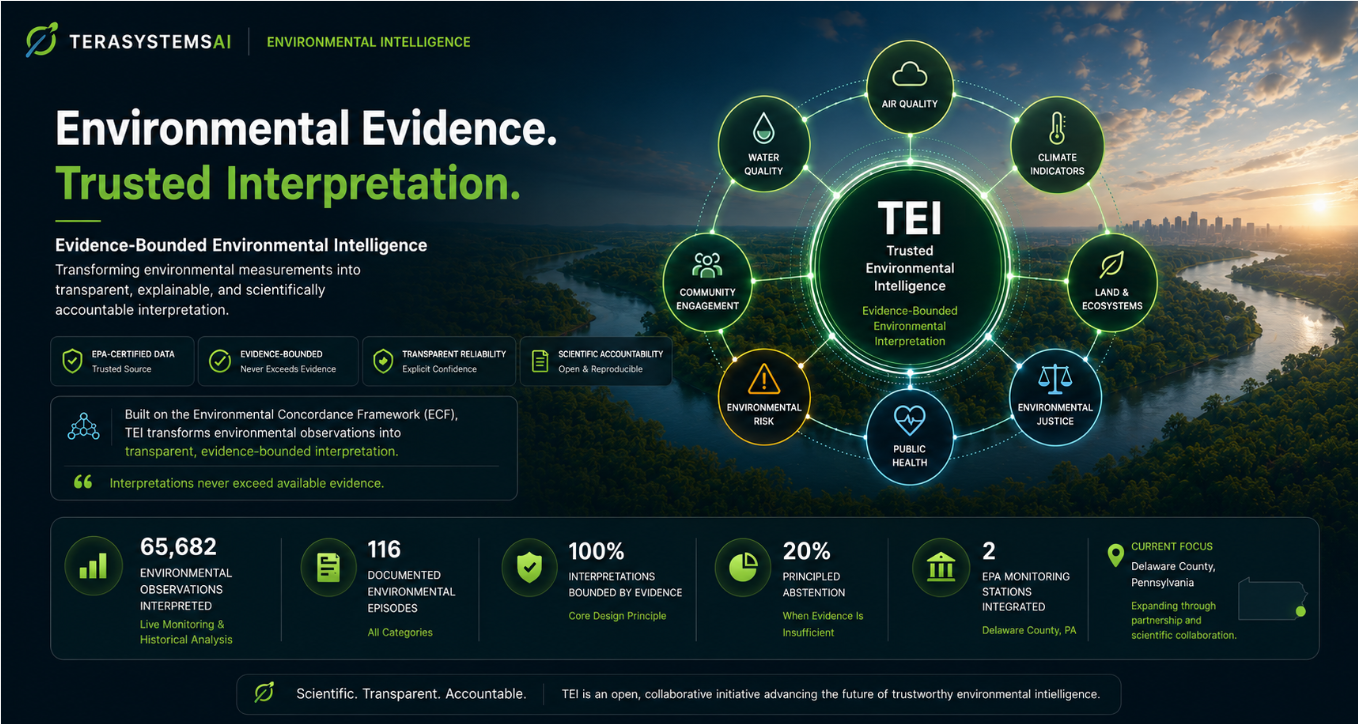
MissingTEI addresses the interpretation gap through the Environmental Concordance Framework (ECF), a deterministic reasoning engine that weighs multiple evidence streams simultaneously and only produces an interpretation when those streams converge.
ECF does not generalize. It does not extrapolate. It works within the evidence that was actually collected. The formula encodes a single principle: an environmental episode deserves an interpretation only when the signal is strong, multiple sites agree, and no confounders undermine the conclusion. When that standard is not met, the engine abstains and records why.
When evidence is insufficient, TEI records that explicitly rather than inferring an answer the data cannot support. This is not a failure mode. It is scientifically more defensible than overconfident interpretation.
C(E)Signal Concordance: normalized agreement in peak timing and magnitude across monitoring sitesD(N)Inter-Site Agreement: discount factor for episodes where fewer than N=2 independent sites corroborate simultaneouslyL(E)Confounder Load: penalty for confounding meteorological or source conditionsR(E)Reliability Score: 0 to 1. Interpretations are registered only when R(E) exceeds the calibrated thresholdEvery TEI run yields the same four artifacts for each episode, each one traceable to the evidence that produced it.
A discrete status for each episode: regional transport, inter-site divergence, uncertain, or insufficient evidence.
What happenedA deterministic score R(E) from 0 to 1 stating how strongly the evidence supports the interpretation.
How confidentThe exact signals, sites, and meteorological context cited for each conclusion. Nothing is asserted without a source.
WhyA permanent, structured record of all episodes with 34 fields each, fully reproducible from source data.
Recorded permanentlyFour stages transform certified sensor readings into structured, auditable interpretations stored permanently in the Trustworthy Event Registry.
EPA AQS certified PM2.5 data across all available years is ingested and episodically segmented. Each elevation event is identified by duration, magnitude, and site coverage.
IngestFor each episode, ECF computes a reliability score R(E) from signal concordance, inter-site agreement, and confounder penalty. When R(E) exceeds threshold, an interpretation is registered.
ScoreA real-time tier uses AirNow near-real-time data to surface current conditions for the study region. This tier is observational context, not certified interpretation.
ObserveERA5 reanalysis data provides wind direction, boundary layer height, and temperature inversion context, allowing distinction between regional transport and local source contributions.
ContextualizeECF integrates only certified or reanalysis data sources. No nowcast estimates or modeled concentrations are used in interpretation. Every evidence record is traceable to a specific source dataset.
Federal Reference Method measurements from Delaware County monitoring sites (FIPS 42045), sampled hourly. Submitted to EPA, quality-assured, and certified.
Regulatory CertifiedOpen-Meteo ERA5 hourly reanalysis: wind speed and direction, boundary layer height, surface pressure, and temperature. Used to classify transport conditions and detect confounders.
ECMWF ReanalysisEPA AirNow API provides current PM2.5 concentrations. Used exclusively for the real-time monitoring tier, not for TER interpretation. Preliminary data, not certified.
Monitoring OnlyThe TER is the structured output of ECF: each row is an environmental episode, each column is a measured quantity or derived interpretation field. 34 columns per episode. All fields are traceable to source data.
Four interpretation statuses. Each episode receives exactly one.
Multi-site concordant elevation consistent with upwind source transport. Wind direction and timing align. High R(E).
Sites disagree on magnitude or timing. Spatially heterogeneous signal suggests local source proximity differential.
Evidence is present but below the confidence threshold. Engine abstains and records why.
Fewer than two sites active or meteorological data unavailable. No interpretation possible.
ECF v0.1 · Delaware County PA · 2022-2025
TEI is a research initiative. These are the scientific and engineering questions we are actively investigating.
Developing and refining the deterministic concordance methodology for multi-site environmental episode interpretation.
MethodologyFormalizing the principle that environmental interpretations should never exceed the available evidence, and building systems that enforce that constraint.
Core PrincipleQuantifying how reliably environmental interpretations can be made from available monitoring data, and communicating that reliability transparently.
QuantificationResearching how environmental uncertainty should be communicated to diverse audiences: regulators, public health professionals, and communities.
CommunicationEnsuring every interpretation produced by TEI can be understood, challenged, and reproduced by domain experts without requiring AI expertise.
TransparencyInvestigating how AI systems can support environmental decision-making while remaining bounded, auditable, and scientifically defensible.
AI SafetyResearchers collaborate around questions. These are the questions that drive the TEI research agenda and where we welcome independent investigation.
How should environmental interpretation communicate uncertainty to regulators, clinicians, and communities without sacrificing scientific precision?
What defines trustworthy environmental intelligence, and how can trustworthiness be measured rather than merely claimed?
How should interpretation reliability be quantified when the evidence base varies in completeness across monitoring regions?
How should AI-assisted environmental systems remain bounded by available evidence while remaining useful for real-world decision support?
How should conflicting environmental observations from multiple monitoring sites be reconciled into a coherent interpretation?
The platform demonstrates the methodology in practice. Browse all 116 episodes, inspect per-episode evidence records, and review the ECF interpretation rationale. The platform is the evidence of the approach, not the centerpiece.
Every TEI interpretation is deterministic, auditable, and constrained by the evidence that produced it. The Environmental Concordance Framework scores reliability from verified monitoring data. The Trustworthy Event Registry preserves every interpretation permanently. No black boxes. No subjective overrides. No claims beyond what the data supports.
This methodology is designed for collaboration. Researchers, public agencies, universities, and health organizations can independently validate, extend, and build upon the ECF framework.